
Our multi-age, child-led program is inspired by the world-renowned Reggio Emilia philosophy of education. Nature-based learning is woven throughout our program, enriched by our outdoor yard and our close proximity to beaches, parks, and woodlands.

The Reggio Emilia approach is known for its student-initiated, inquiry-based, and interdisciplinary model of education. This philosophy aligns closely with our teaching values, and we view it as a proven and effective pedagogical framework.
While Reggio Emilia originated within a specific Italian cultural context, we thoughtfully adapt its principles to reflect our own community, environment, and location.
The following five core principles of the Reggio Emilia approach guide our program:
• The environment as the third teacher
• The child as protagonist, collaborator, and communicator
• The teacher as partner, nurturer, guide, and researcher
• Documentation and narration as communication
• The parent as a partner / part of the community
THE LEARNING ENVIRONMENT
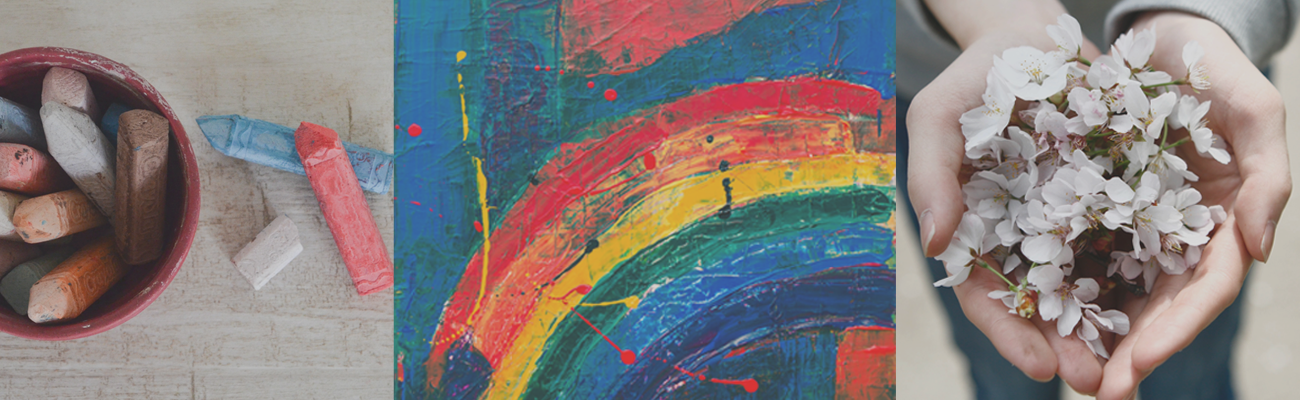
Our learning environment is thoughtfully designed to support children’s natural curiosity, creativity, and sense of belonging. We see the physical space as “the third teacher,” with each material, area, and experience intentionally chosen to invite exploration, imagination, and meaningful play.
Inside, the space is warm, welcoming, and calming—a place where children can feel comfortable, grounded, and at home. Attractive, age-appropriate materials are carefully arranged to encourage sensory discovery, independence, and engagement at each child’s own pace. Our aim is to create what L. Gandini describes as an “amiable space”: an environment that feels inviting, responsive, and full of possibility.
The indoor environment flows naturally into our outdoor play areas, creating a sense of continuity between inside and outside. Large windows bring in light and frame views of the yard, allowing nature to become part of the children’s everyday learning experience.
Outdoors, children enjoy a private, enclosed play space with a sandpit, water area, mud kitchen, garden beds, and a sheltered area for all-weather play. Both the indoor and outdoor environments support quiet moments, active movement, individual exploration, and collaborative group experiences.
We believe children thrive in spaces rich with discovery, beauty, connection, and wonder.
“Enrolling our child at Greenhouse was the single best decision we have made as parents.
Our son has thrived in its creative and nature-forward environment, guided by skilled educators.
Thank you Rebecca, Cara, Carie and Anastasia for seeing our child as he is while helping him grow into the best version of himself. We are forever grateful for your guidance and community through these foundational years.”
-Andy Zeelie-Varga

A PLAY-BASED EMERGENT CURRICULUM
Our emergent curriculum grows naturally from conversation, provocation, observation, and reflection. Rather than following a predetermined or fixed lesson plan, we create space for children’s ideas to be tested, questions to be explored, and interests to unfold at their own pace.
Through pedagogical narrations, we observe and document learning as it happens, teasing out meaning from children’s play, conversations, relationships, and discoveries. This reflective process helps shape our program and informs the choices we make when selecting play materials, planning activities, and offering new provocations for deeper exploration.
Open-ended, child-led play is central to this approach. When children are offered materials without a single expected outcome, they are free to imagine, experiment, problem-solve, collaborate, and express their ideas in many different ways. This opportunity for play supports creativity, communication, flexible thinking, independence, resilience, self-regulation, and confidence.
At Green House Studio, we value the creative process for its own sake, not as a means to produce a finished product or meet an adult-directed outcome. Children are free to begin, continue, adapt, or leave an activity when they are ready. Without the pressure of external approval, they can stay deeply engaged in the creative process until it reaches its own natural conclusion.
We also recognize that children express their knowledge in many ways before they are able to read or write. They communicate through language, drawing, painting, clay, collage, movement, performance, construction, and imaginative play. These many forms of expression are often referred to as “the hundred languages of children.” Our program offers rich opportunities for these diverse forms of individual expression to flourish.
THE FOLLOWING ARE SOME CONCRETE EXAMPLES OF ACTIVITIES SPANNING THE DEVELOPMENT AREAS:


NATURE-CONNECTED LEARNING
At Green House Studio, we aim to nurture children’s appreciation, curiosity, and respect for the natural world. We believe that meaningful time in nature supports children’s well-being, imagination, confidence, and sense of connection—to themselves, to others, and to the environment around them.
Nature is woven into our daily rhythm through outdoor play, local excursions, seasonal observations, and carefully chosen indoor provocations. Whether children are collecting leaves, noticing changes in the weather, observing insects in the garden, or exploring natural materials inside the studio, they are invited to slow down, look closely, ask questions, and engage their senses.
Our outdoor space includes a garden growing area where children can help care for plants and experience the process of planting, tending, harvesting, and renewal. Through these hands-on experiences, children begin to notice the rhythms of the seasons and the relationships between plants, soil, insects, birds, animals, weather, and people. These moments offer rich opportunities for wonder, responsibility, patience, and discovery.
We also strive to model care for the environment through the choices we make as a program. Whenever possible, we choose natural, durable, and sustainable materials, and we give new life to items that might otherwise be discarded. Reusing and repurposing materials not only reduces waste, but also invites creativity, imagination, and flexible thinking.
Our goal is to support our children and do our small part to contribute to a healthier planet—helping children grow with a sense of care, connection, and responsibility for the world they are part of.
“Nature inspires creativity in a child by demanding visualization and the full use of the senses.”

OUR TYPICAL DAILY SCHEDULE IS AS FOLLOWS:
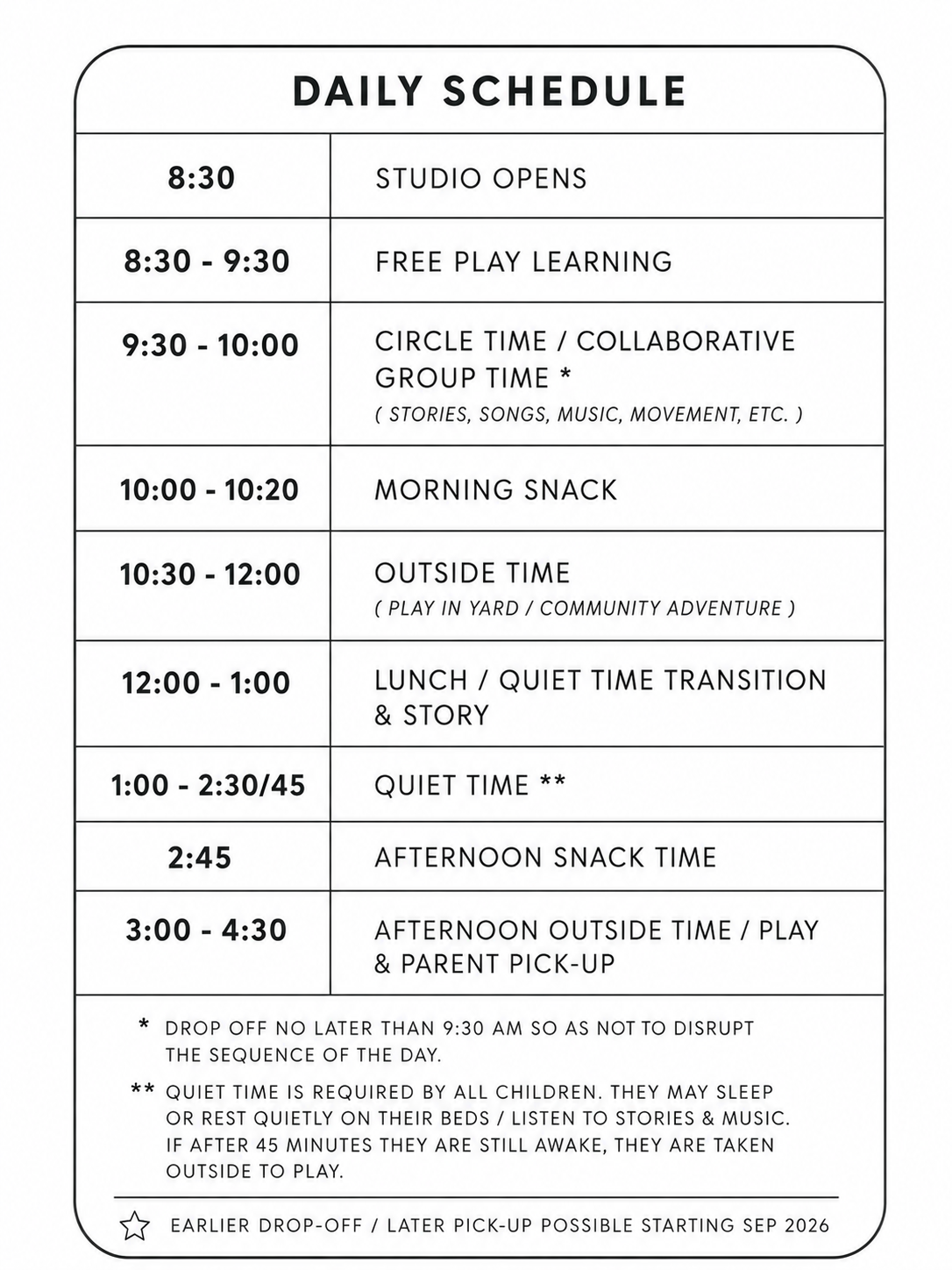
We spend time outside twice a day, rain or shine! We have a large sheltered area to enable us to stay comfortable & have fun in all weather.
THE EDUCATOR’S ROLE
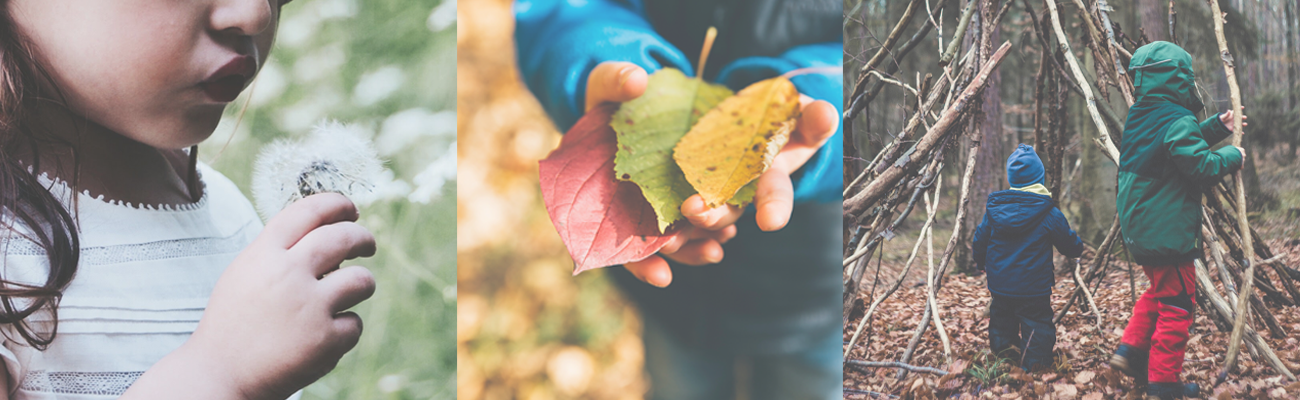
As educators, our place in the environment is to facilitate the exploratory process by observing, listening, reflecting and responding to the children as they work at play; a partnership of learning and growing together with the children leading the way. We provide the children support balanced with autonomy, to allow for personally meaningful goals.
Blurring the separation between teacher and student, we believe, brings the teacher down off their powerful pedestal (found in some learning environments) to a place of collaboration, where children aren’t fearful of being wrong. In turn this creates a more welcoming, warm environment fostering care, appreciation, respect and more creative outcomes.
Our low ratio gives space for extra teacher input and helps to inspire and guide, to listen, respond, question, and otherwise support the children in their creative explorations.
“The Green House Studio has been a dream come true for our family. it has been a home away from home for our kiddos. The space is bright and welcoming, the educators are so skilled and caring, and my heart is at ease knowing that our children receive the best care in a small community, when not at home with us. I love that the children go outside every day for adventures, play, and fresh air. I love that the kids get a chance to create art projects, learn new songs and stories, and explore the world with their peers. The Green House Studio is everything I had hoped for in a daycare setting. As a bonus, we have connected as a community with the other families which has been such a gift. We're so grateful!.” -Glenna Garramone
PARENT ENGAGEMENT
The Reggio Emilia philosophy is rooted in collaboration between children, educators, families, and the wider community. It was built on the belief that children’s learning is strengthened when the people around them work together, share perspectives, and remain connected. When families are actively involved in their child’s early learning experience, the divide between “school” and home becomes softer and more meaningful.
At Green House Studio, we value open communication and ongoing connection with families. Through documentation of the learning process, parents are invited to see not only what their child has been doing, but how their thinking, relationships, creativity, and confidence are developing over time. Sometimes the process tells a richer story than the finished product—showing the questions asked, challenges worked through, ideas tested, and moments of growth along the way.
Documentation is shared within the Studio, and our private family blog offers another way for parents to stay connected in their own time. Because drop-off and pick-up can be busy transition points, the blog provides a space to share glimpses into the children’s experiences, current interests, project work, and group discoveries.
Families are warmly invited to contribute their own thoughts, ideas, and reflections in response to our ongoing projects. This helps create a shared understanding between home and the Studio, and gives parents the opportunity to continue conversations with their child beyond the daycare day.
We are more than just a daycare. Green House Studio is a community of children, educators, and wonderful families, and we warmly welcome you to be part of it.
Green House Studio wishes to recognize and acknowledge the Esquimalt and Songhees Nations on whose traditional territories we live, work and play.
JOIN OUR FAMILY
GREEN HOUSE STUDIO
